As AI becomes a core touchpoint for automotive consumer decision-making, the answers provided by AI when users search for queries like "200,000 RMB new energy SUV recommendations", "how to choose family-friendly intelligent driving models", or "long-range electric vehicle rankings" directly determine whether a brand can enter the car purchase candidate pool. However, many automotive brands, despite having suitable models, remain "invisible" in AI responses due to a lack of understanding of Generative Search Optimization (GEO), missing out on high-quality customer traffic.
An automotive brand focusing on intelligent driving and new energy sectors once faced this dilemma—until it introduced the dtcpack GEO tool. Through three months of targeted optimization, it successfully achieved dual breakthroughs in brand visibility and information accuracy in AI responses.

Case Background
The brand's core business covers family-friendly new energy vehicles and high-level advanced driver assistance technologies, but its performance in AI responses had obvious shortcomings:
-
The brand mention rate in AI responses to high-frequency automotive industry questions (e.g., "recommendations for intelligent driving family cars", "long-range electric vehicle selection") was only 4%;
-
The accuracy rate of associating the few mentions with core selling points (e.g., "standard Level 2.5 intelligent driving", "1200km combined cruising range") was merely 25%, often being misclassified as "high-priced models" or "short-range products";
-
The proportion of high-quality traffic directed from AI responses to the brand's official website was less than 8%, missing the opportunity to reach users in the early stage of car purchase decision-making.
To address this dilemma, the brand fully launched the DTCPACK GEO tool suite, focusing on optimizing "visibility in AI responses + information accuracy".
Core Application Strategy of DTCPACK GEO Tools
Relying on the four core functions of DTCPACK, a full-link GEO solution of "diagnosis - optimization - monitoring - iteration" was built, accurately matching the user decision-making scenarios in the automotive industry:
1. GEO Brand Audit: Lock Baseline Data in AI Scenarios
First, the full-scenario data diagnosis was completed through DTCPACK GEO Brand Audit" function:
-
Covered 12 high-frequency AI query scenarios in the automotive industry (including new energy vehicle recommendations, intelligent driving adaptation, family car space comparison, etc.);
-
Clarified core baselines: the average brand mention rate in AI responses was 4%, the accuracy rate of core selling point association was 25%, and 3 high-potential scenarios such as "beginner intelligent driving models" and "family long-distance self-driving electric vehicles" were not covered.
2. Prompt Evaluation: Break Through Barriers in AI Response Competition
In view of the fierce Prompt competition in the automotive industry, DTCPACK "Prompt Evaluation" function was used to quantify the exposure difficulty of different queries:
-
Identified that the competition intensity of popular Prompts such as "200,000 RMB new energy SUV recommendations" reached a high level , while the competition intensity of scenarios such as "real-world tests of family-friendly intelligent driving SUVs" and "recommendations for long-range electric vehicles" was moderate , determining the optimization direction of "avoiding hotspots and targeting medium-competition areas";
-
Optimized content expression: transformed professional terms like "Level 2.5 Navigation on Autopilot (NOA)" into "family-friendly intelligent driving with AI automatic following + lane keeping", simplified "CLTC combined cruising range of 1200km" to "1200km+ range on full fuel and electricity, no anxiety for long distances", and embedded high-frequency keywords captured by AI.
3. GEO Screenshot Monitoring: Dynamically Track AI Response Performance
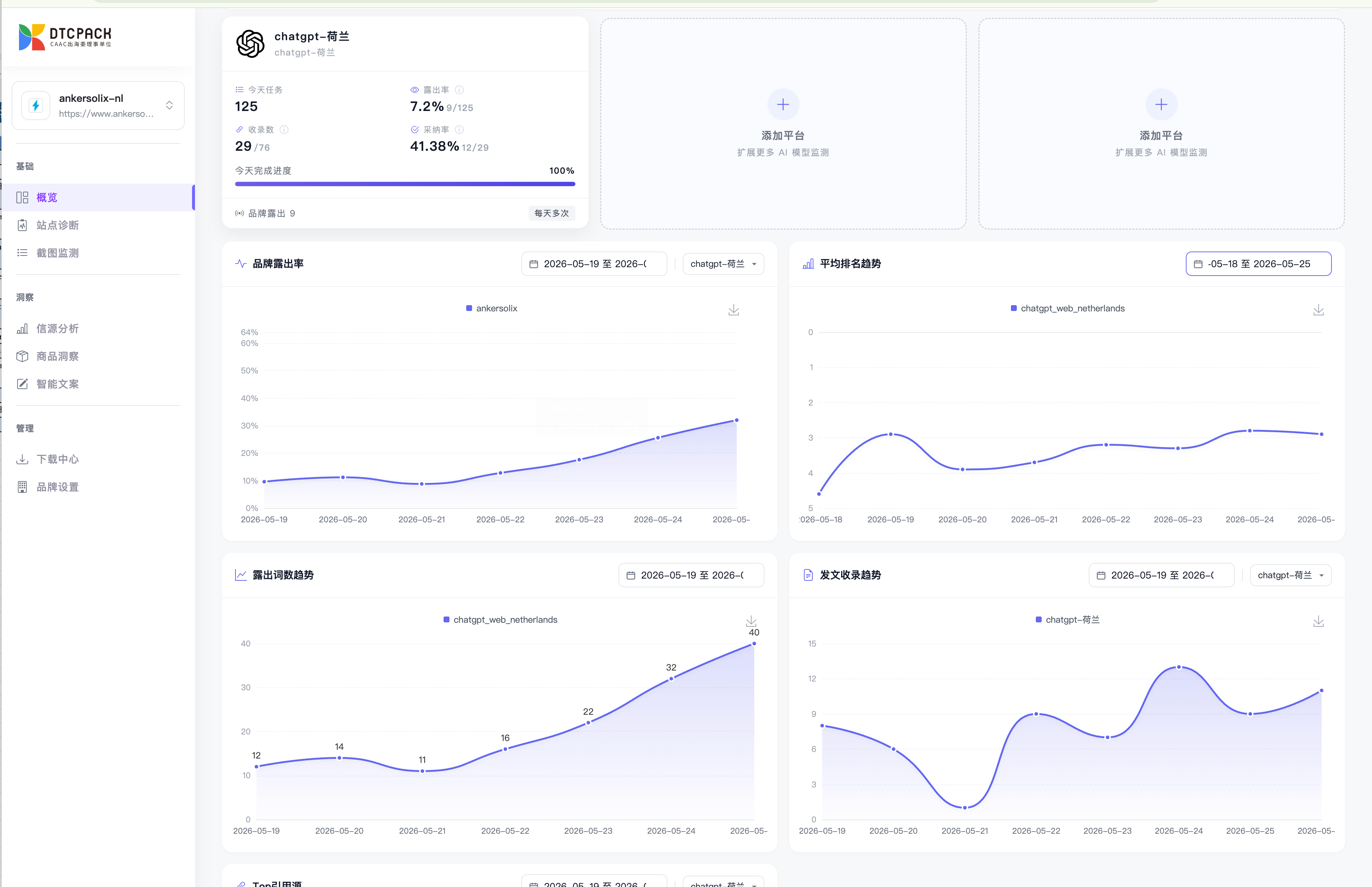
Activated DTCPACK daily full-scale monitoring function, covering 10+ mainstream generative AI platforms:
-
Real-time tracked the brand's mentions in scenarios such as "intelligent driving model comparison" and "new energy family car selection";
-
Released weekly optimization reports, and supplemented content such as vehicle space and child safety configurations to AI information crawling sources like Autocar and Top Gear for high-frequency scenarios where the brand was not mentioned (e.g., "recommendations for electric vehicles for two-child families").
4. LLMs-TXT Generator: Reconstruct AI-Friendly Content
Through DTCPACK "LLMs-TXT Generator", an AI-adapted content system exclusive to the automotive industry was created:
-
Transformed vehicle parameter tables into "keyword-first + bullet-point" text (e.g., "Core Advantages: 1. Standard Level 2.5 intelligent driving across the entire series; 2. 1200km combined cruising range; 3. Five-seat large space + convenient child safety seat interfaces");
-
Built an "AI response-adapted content library" and generated scenario-based response scripts for high-frequency user questions such as "Is intelligent driving reliable?" and "Is the long-range of electric vehicles sufficient?".
Optimization Results After Three Months
After continuous implementation, the core indicators of the brand in AI response scenarios have achieved significant improvement:
-
Brand mention rate in AI responses to high-frequency automotive questions: increased from 4% to 16%;
-
Accuracy rate of associating brand core selling points (intelligent driving, long cruising range): increased from 25% to 73%;
-
Proportion of positive and accurate recommendations of brand models in AI responses: increased from 15% to 55%;
-
High-quality website traffic from AI responses: increased by 38% month-on-month;
-
Proportion of potential user consultations where "learning about the brand through AI": increased from 6% to 29%.
Case Summary
At a time when AI is restructuring the automotive consumer decision-making link, DTCPACK GEO tools help brands achieve efficient exposure in the AI response ecosystem through full-process capabilities of "data diagnosis to identify pain points, Prompt optimization to break through competition, dynamic monitoring to adjust strategies, and content reconstruction to improve adaptability". This practice proves that the core of GEO optimization in the automotive industry lies in "scenario matching + AI language transformation", and the standardized tool suite provided by DTCPACK offers a directly reusable solution for automakers to seize the AI traffic entrance.
FAQ
Q1: What is the core difference between DTCPACK GEO tools and traditional SEO?
Traditional SEO focuses on keyword rankings in search engines, with the core of adapting to search engine indexing rules; while DTCPACKGEO tools target the response logic of generative AI, focusing more on "AI comprehensibility" and "business scenario relevance" of content. Through functions such as Prompt Evaluation and LLMs-TXT Generator, they make content more in line with the content crawling and output preferences of AI.
Q2: Are there compliance risks for the automotive industry in using GEO tools?
DTCPACK GEO tools only optimize the presentation form of content and its adaptability to AI, and do not involve illegal collection or dissemination of automotive-related data (such as vehicle safety data, user privacy information). The compliance of the content itself needs to be independently controlled by automotive brands in accordance with regulatory requirements such as the "Regulations on the Administration of New Energy Vehicle Production Enterprises and Product Access". The tools will not increase additional compliance risks.
Q3: How long does it usually take for automotive brands to see significant results using this tool?
Based on this case and similar practices, significant improvements in core indicators (mention rate, association accuracy) can usually be seen after 3-4 months of continuous optimization; if the brand has a good content foundation and high coverage of information sources (such as complete official website content and rich industry platform layouts), the effect cycle can be shortened to about 2 months.
Q4: Is a professional technical team required to use DTCPACK GEO tools?
No. Functions of the tool (such as GEO Brand Audit and Screenshot Monitoring) are all operated through a visual background, and the output reports and optimization suggestions are clear and easy to understand; the LLMs-TXT Generator also provides standardized templates for the automotive industry. The brand's marketing or content team can complete the operation independently without professional technical capabilities.
Q5: Can targeted optimization be carried out for specific generative AI platforms (such as ChatGPT,)?
Yes. DTCPACK GEO tools support monitoring the content crawling logic of mainstream generative AI platforms, and can adjust content keywords and structures to adapt to the algorithm preferences of different platforms. In this case, targeted optimization for 10+ mainstream AI platforms has been covered, and the optimization strategy can be flexibly adjusted according to the platform characteristics where the brand's target users are concentrated.